The VC-Backed Casino
VCs have historically overlooked online casinos. That’s about to change.
March 2026

There’s a gap between how Americans view DraftKings and how the company views itself.
Most Americans see a sports betting business. But DraftKings – as well as Flutter/FanDuel, Bet365 and other real-money gaming giants – really want to be in the online casino business.
Recently DraftKings made this clearer than ever at their 2026 investor day. They announced plans to launch a DraftKings Super App that will integrate its sportsbook, prediction markets, casino and lottery products into one app for the first time.
The strategic thinking is: Acquire users via low-margin sports betting products, and cross-sell them to extremely high margin online casino products.
Already, online casino drives ~25% of revenue and ~50% of EBITDA for DraftKings. That’s despite online casino being legalized in only 8 US states, compared to 32 states for online sportsbooks.
Now here’s the interesting thing. Since the 2010s, sports betting companies have raised billions from the world’s largest VCs. But online casino companies have raised very little VC funding.
At Will Ventures, we believe that’s about to change. We believe new multi-billion dollar online casino businesses will be built over the next decade, and we think VCs are going to start paying attention. This essay explains why, split into three parts.
Part 1 explains why online casinos are such fundamentally attractive businesses
Part 2 explores why online casinos have been overlooked by VCs, and why that will change
Part 3 outlines where we at Will Ventures see room for innovation, and believe multi-billion dollar online casinos will emerge
Part 1: Why online casino
One great poster child for the online casino industry has been Betty.
Betty (a Will Ventures portfolio company) launched an online casino in Ontario, Canada and scaled from $0 to a $328M run rate in under 3 years.
For perspective, ElevenLabs (one of the world’s fastest-growing AI companies) recently said it went from $0 to $300M ARR in 3 years.
The comparison isn’t apples-to-apples. But it underscores that online casinos can grow as fast as any business in the venture ecosystem.

That’s because online casinos are structurally incredible businesses. Let’s look at the reasons the online casino business model is superior to the sportsbook model.
- On revenues: Casino gameplay is continuous, so a single player can make hundreds of bets per session, any hour of the day. Meanwhile, a sports bettor can only bet when games are on, and they need to wait hours for games to end. As a result, online casino has higher LTVs and no seasonality.
- On costs: Once a casino secures licenses and stands up a site, incremental gameplay requires near-zero marginal cost. Meanwhile, sportsbooks spend heavily on trading teams, market-making infrastructure, risk management, and sports data and league fees. Sharp bettors are a big reason for these costs; sportsbooks will either lose money to them, or spend on trading, profiling and limiting tools to mitigate them. But casinos don’t have these sharps and other cost centers, so they can run 30%+ EBITDA margins, which look more like software than gaming businesses.
- On volatility: Slots and table games (e.g. blackjack) have mathematically-fixed edges, which means predictable margins. Sportsbooks have volatile margins based on game outcomes. So casino operators have a clear line of sight from GGR to profits.
So what do these fundamentals mean? Once a casino nails a positive LTV-CAC ratio, they can pour fuel on the fire – reinvesting profits and/or raising capital – to grow incredibly quickly like Betty in Canada.
There are also more non-dilutive financing options popping up, like General Catalyst, 23 Broadway and PvX Partners, which provide cohort-based financing. That lets companies scale without diluting management or early equity investors.
Another thing to like is casino incumbents feel like dinosaurs. Compare the sites and app store profiles of Ladbrokes, an Entain-owned legacy brand, and Midnite, a fast-growing UK-based startup. Midnite has way more modern branding and UI/UX, and they definitely have more modern backend tech to acquire users, bonus VIPs, and offer better customer service.

The reason these dinosaurs exist is most of the world’s largest real-money gaming operators have all grown through acquisition, not organically. For example, Flutter, a $18 billion conglomerate, operates 15+ brands, all thanks to acquisitions / mergers. Entain, worth $3.5 billion, operates 35+ brands. These are marketing-led, not product-led, businesses. But paid acquisition has become commoditized; anyone can buy a Meta ad. So the incumbents are vulnerable to product-led startups. It’s worth noting that FanDuel disrupted incumbents by being a product-led startup in the 2010s, and they’re now Flutter’s crown jewel.
These startups are also going to benefit from major tailwinds behind online casino.
In 2009, 40% of Americans participated in some form of gambling. By 2025, that skyrocketed to 57%.
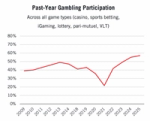
People have cited many reasons for gambling’s recent explosion. Derek Thompson has written about Gen Z’s financial nihilism. Jonathan Haidt has drawn a throughline from phone and short-form video addiction. Mobile phone penetration and digital payments have made gambling more accessible than ever. And regulators have realized that if they don’t legalize gambling, people will just do it offshore with fewer taxes and less consumer safety. So the secular trend of the last 20 years has been slow but steady legalization around the world. In sum, there are cultural, economic and political tailwinds behind online casino.
We’ll mention one last reason the online casino business is interesting. It’s more anecdotal. But in the last few years, we’ve seen a surge of brilliant people moving from finance and tech jobs into the gambling industry. We’ve met quants at Citadel and engineers at Meta leave their high-paying jobs to start or join gambling businesses.
Why? Nate Silver’s book “On the Edge” argues that many hedge fund traders, tech founders, and pro gamblers are cut from the same cloth. They often think in terms of expected value and probabilities. (Hence why so many founders play poker, and why so many VCs host poker nights). Talented young people in finance and tech are seeing a gold rush with online gambling and they’re leaving to build companies in the space.
Part 2: What about the VCs
So if online casinos are such attractive businesses, why haven’t more VCs paid attention to the space? We’d point to three reasons.
First, there’s a geographic dislocation between where VCs live and where casino founders live. The bulk of VC money is in the US. But most real-money gaming talent is in Europe. Post-PASPA, American sportsbooks all rushed to hire this talent. DraftKings bought SBTech, MGM partnered with Entain, and FanDuel brought over PaddyPower executives post-Flutter acquisition. So if you’re a VC camping out in a San Francisco Blue Bottle, you’re probably not meeting the best real-money gaming founders.
Second, online casino is a highly-regulated industry, and VCs don’t love that. High regulation means high taxes, compliance burdens, and the possibility of a single policy change or licensing delay wiping out years of progress. Highly-regulated markets also require deep industry expertise to make smart investments, so generalist VCs often steer clear of these spaces. That’s also why you don’t see many generalists dabbling in core healthcare.
Third, and most importantly, are “vice clauses.” The largest LPs of VC funds – namely pension funds, university endowments and sovereign wealth funds – have historically had clauses that prohibited investments in vices like gambling, tobacco, alcohol, and porn.
Many LPs dropped sports betting from their clauses post-PASPA. And we think more LPs will inevitably drop casino. Why?
In the last few years, Americans have seen a convergence between fintech and gambling products. Robinhood is a $68 billion company that calls itself a financial management tool, but really encourages people to day-trade stocks. Coinbase is a $51 billion company that also calls itself financial management, but encourages people to put savings into volatile crypto assets.
And perhaps the best examples are Kalshi and Polymarket, which hit $10+ billion valuations by taking bets on sports, politics and Super Bowl halftime shows. Their founders call them financial management platforms. But in reality, 90% of volume during the NFL season came from sports, so they feel a lot like sportsbooks. Polymarket’s also seen an explosion of 5- and 5-minute crypto markets. Betting on whether Bitcoin will be up or down in 5 minutes is functionally a slot game.

Financial speculation is a spectrum, with responsible investment on one side and gambling on the other. Robinhood, Coinbase and Kalshi all sit in the blurry middle. It’s hard to draw a clear line and tell people how risky they can be with their own money.
These companies also showed VCs how valuable gambling mechanics could be. Kalshi started as a relatively boring company where users could trade weather derivatives and elections once every four years. But once they added sports, everything clicked. Suddenly users had many events they cared about and reasons to come back every day, creating a sticky experience. Kalshi’s been a rocketship since. Sequoia and a16z emphasized they almost never co-lead deals, but the company was just that exciting.
We expect more VCs to see the opportunity in casino, adjust their LP agreements, and begin investing in the space.
Part 3: Room for innovation
Where is Will Ventures excited to invest in the casino space? We’re paying attention to two megatrends.
First is the interplay between onshore and offshore casinos. Offshore operators have driven the vast majority of innovation in recent years. For example, Stake pioneered the casino livestream, turning gambling into a media product and building a massive creator-driven distribution channel on Kick. Stake also created original house games, rather than just porting traditional games onto the internet. Shuffle introduced a token to make it feel like users’ interests were aligned with the house. Rollbit merged the casino and trading platform experiences by letting users bet on Bitcoin movements.
Thanks to this product innovation, offshore casinos have boomed since Covid. By some estimates, about two-thirds of US gambling revenue happened on offshore casinos last year. Another data point: Stake reported $4.7 billion in 2024 revenue. For perspective, DraftKings reported $4.8 billion (and definitely has way worse margins than Stake).
The problem is offshore operators can’t go public and don’t have a universe of acquirers. So they trade at 0.5-1x revenue (vs 3-5x for regulated operators). That’s why we’re seeing a wave of offshore operators seek onshore licenses. For example, Stake recently announced a five-year license in Denmark. But it’s still to be seen whether the massive offshore casinos that emerged in the last few years can find stable ground. Either way, we’re watching them because they’re at the forefront of product innovation.
The second megatrend we’re watching is the impact of AI. On the surface, online casino checks every box for an industry about to be impacted by AI: large datasets, personalization opportunities, and fast feedback loops. It’s easy to imagine a world where game suppliers make content faster and cheaper with AI; operators offer VIP customer service through AI chatbots; and gamblers get served casino experiences perfectly tailored to their preferences. That said, we’re curious to see whether the value accrues to B2C operators building these products or B2B providers selling tools.
At Will Ventures, when evaluating a new casino investment, we’re looking for a combination of three factors: 1) new products, 2) new distribution, and 3) new markets.
New products
The first thing we’re looking for is a brand that’s bringing net-new casino experiences to the consumer. For example, BetHog (a Will Ventures portfolio company) recently launched the first AI-powered blackjack dealer. Live dealer games are a multi-billion dollar global market. Evolution, the largest live dealer game supplier, has a $13 billion market cap. BetHog’s disrupting that market with a dealer that’s cheaper to provide, always-on, and knows the user better.
We’re also looking for casinos that are using AI to personalize the consumer journey. For example, let’s say you love watching Italian Brainrot videos on Tik Tok. A casino should serve you Italian Brainrot-themed ads, let you play Brainrot-themed slots, and even send you a giant Brainrot plush as a VIP benefit. Last year Stake launched the Stake Engine, which will allow anyone to build their own games for the platform. More customizable games are a first step. But ideally the entire user journey should be unified, from user acquisition to content to retention bonuses.

New distribution
The next thing we’re looking for is novel distribution and acquisition strategy. Crypto casinos reached the masses by growth hacking social media. Stake used clipping to flood social media with its logo. Rollbit launched its own meme coin that it encouraged influencers to promote on social. Even Kalshi tried giving every affiliate on X a Kalshi badge.
Our bet on the next growth hacks? GEO (aka SEO for ChatGPT) will be a priority for operators, as more users look to AI to find a casino to play on. We also think AI influencers are going to become a cheap affiliate channel, and we’ve already met some brands experimenting with them. As long as social media exists, new growth hacks will emerge, and operators will leverage them to grow their user base.
We’re also bullish on the integration of the casino and streamer experience. It’s clear that streamers playing casino games is a fun media product and an effective acquisition channel. But the Kick and casino experiences live on separate platforms. We’re curious how the two experiences will get further integrated. For example, could a casino embed a stream in their platform, and let gamblers play alongside their favorite streamer? Or could a streamer like Clavicular use their moment in the sun to create a new casino for their community?
Lastly, we’re interested in the convergence of online and retail casino. At NEXT New York a few weeks ago, Betty’s CEO Justin Park talked about how Betty acquired a brick-and-mortar bingo hall in Ontario. Brick-and-mortar brands like MGM and Caesars have entered the online space. But before Betty, no online-native platform has entered brick-and-mortar. Imagine if Stake launched an in-person resort. They’d have a better understanding of their players and offer a fun and fresh brand. So much of the casino user experience hinges on customer service and loyalty. As a casino has more assets to sell and optimize the experience across, the stickier the brand becomes.

New markets
The US is a tough market for online casino, since it’s legalized in only 8 states today. However, we think a second-order effect of prediction markets’ explosion could be the further normalization of gambling and more legalization of iGaming. Different regulatory frameworks will also further the normalization of casino. Sweepstakes casinos like VGW had a strong run until recent state crackdowns. And both collectible repacking products like Triumph Rips and many prediction market products like Kalshi’s Bitcoin markets feel a lot like casinos. We think the more people are playing these games, the less states will wait to regulate and capture the tax revenue. Nevertheless, state-by-state legalization is going to move slowly.
The more interesting opportunity is looking to emerging markets, where playbooks that have worked in more mature markets can be applied. For example, Brazil, the largest market in LATAM, launched regulated online casino in 2025. New brands like EstrelaBet have grown quickly by building a Gen Z-native brand and tapping into local sponsors and soccer partnerships. Mexico is LATAM’s second-largest market, where the regulation is a bit more patchwork, but startup operators like Draftea have started to gain market share.
Other interesting markets we’re paying attention to are Finland, the UAE, Chile and New Zealand, where governments are actively considering or implementing new gambling frameworks that will open large online casino markets over the next few years.
##
In sum, at Will Ventures we see plenty of room for innovation in the online casino space, and we’re excited to invest in the category.
If you’re looking to build the next multi-billion dollar casino and parts of this essay resonated with you, please reach out. We’d love to meet you.